Night Runner
Cat PersonNight Runner is a local supernatural explanation for nocturnal harassment that changes the meaning of Aaron’s frightening encounters in Butula. Grace describes the Night Runner as a real person, not a spirit, yet one who can become an animal when pursued; by the end, Aaron himself appears to the girls as the very kind of terror he has been trying to understand. The story leaves the belief suspended between explanation, teasing, and an experience that neither Aaron nor the reader can settle neatly.
Grace’s account of the belief
Grace tells Aaron that Night Runners are common among the Luhya and cause trouble by running around naked at night. She performs the story as she tells it: making pounding noises, gesturing as if someone were rubbing himself against a wall, and describing the possibility of a filthy gift left behind. Her theatrical delivery initially makes the account sound like another of her outrageous fabrications. She has previously told Aaron supernatural stories about a man cursed to crow whenever he urinates and adulterers magically stuck together until surgeons separate them. Those stories, too, had seemed designed to tease his credulity.
This time, however, Grace insists that the Night Runner is a human being driven to run by a kind of demonic mental disorder. The person’s identity stays secret because discovery can bring severe consequences. She recalls a Night Runner captured in a village three villages away and nearly lynched; only afterward did the community learn that the runner was a respected pastor’s wife. The account thus joins a supernatural-sounding explanation to a recognizably human danger: the suspected runner may be a neighbor, while the community’s response can become violent.
Grace’s description also complicates its own claim that Night Runners are human. She says experienced runners work in pairs and perform elaborate rituals to avoid capture, then explains that, when chased, they can become a cat, a bird, or even a leopard. Aaron begins by doubting her, but her apparent conviction wears down his skepticism enough for him to ask how a person can escape one. Grace breaks off the explanation laughing, making it unclear how much of the account is belief, invention, or deliberate play with his seriousness.
The harassment at Aaron’s house
The belief enters the story through Aaron’s experience of being targeted. He tells Grace that people have continued to knock at his house through the night and that the harassment has made him feel isolated. He is ashamed to admit that someone defecated on his veranda; in his account, the obscenity embarrasses its victim more than its perpetrator. Grace’s explanation gives the humiliating intrusion a name, but it does not make it less real or less frightening.
On a later night, Aaron opens the door abruptly and sees bare legs swinging in front of him. A foot lashes toward his face, scratching his cheek, and he swings a lawn mower. The figure escapes upward, leaving the metal blade embedded in the decaying doorframe. Aaron realizes how close he came to seriously injuring a girl. From the roof, the unseen pursuer seems trapped by the high boundary wall, but a fall sounds elsewhere; then the mocking meow comes from behind him. The sequence makes the Night Runner’s supposed ability to change shape feel less like a settled fact than a way of naming Aaron’s inability to keep track of his pursuer.
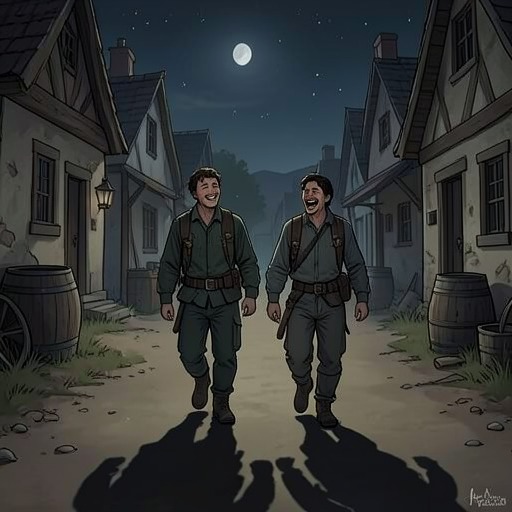
Aaron runs after the figure through dark, empty streets, past closed shops, wet brush, trees, a church, a rubbish dump, and a field of maize. Its outline seems to shift in size, appearing first childlike, then adult, then catlike, before becoming girl-sized again. The pursuit ends at a compound lit by a celebratory fire. The girls have gathered to mark the end of the semester, drinking Coca-Cola or Fanta and eating roasted goat. Aaron arrives exhausted, barefoot, and wearing torn, dirt-covered underwear, with leaves and twigs clinging to his legs. His appearance reverses the chase: the girls see a strange, frightening figure, and one of the older girls calls him a Night Runner. The younger girls’ fear gives way to taunting.
Reversal, recognition, and departure
At the gathering, Aaron briefly sees the scene through the logic of Grace’s stories and imagines that he may be encountering their creatures. Then he sees the bare wall behind him and recognizes that he is the pursuer, not the pursued. That correction does not restore his dignity. To the girls, he is a pale, wild-looking stranger with catlike eyes; their laughter and jeers make him confront the fear his pursuit has caused. The Night Runner has become a social role that can attach to whoever appears frightening in the dark, not only to the unknown figure Aaron has chased.
Grace is present, but she does not fear him. She has laughed at Aaron, told him stories, and frightened him with them; now she runs naked through the courtyard, invisible to everyone except him. Her appearance recalls the Night Runner’s defining nakedness, while her movement echoes the animal agility Grace has described. The story does not explain whether Grace is the person who tormented Aaron, whether the scene is supernatural, or whether she is simply making one final, private joke. What it establishes is that Aaron recognizes her and follows. After deciding to leave the village and return home the next day, he runs with her that night.
The belief therefore does more than account for strange noises or a filthy veranda. It organizes a chain of changing perspectives: Grace presents the Night Runner as both human and capable of transformation; Aaron moves from skepticism to fear, then becomes an object of fear himself; and Grace’s final run leaves the boundary between prank and supernatural encounter unresolved. Its force lies in that uncertainty. The Night Runner is at once a name for nocturnal menace, a story through which Grace challenges Aaron’s seriousness, and the image under which the girls briefly see the disheveled outsider who has chased them into their celebration.